Is Microcement Actually Waterproof? What "100% Waterproof" Marketing Claims Leave Out
Is Microcement Actually Waterproof? What "100% Waterproof" Marketing Claims Leave Out
Ecoflor microcement is a wear-resistant, water-shedding surface finish, applied over a compliant waterproofing membrane, that meets Australian wet area requirements under AS 3740 and AS 4858 when installed as specified. That distinction, finish versus waterproofing membrane, is the one a lot of "100% waterproof" marketing in the microcement industry glosses over, and it matters most in exactly the place buyers care about most: the shower.
The problem with "fully sealed" as a selling point
A shower is not a sealed box. Waterproofing membranes, grout lines, junctions, and penetrations all have some tolerance for moisture getting past the first line of defence, which is why AS 3740 (Waterproofing of Domestic Wet Areas) specifies a full system, not a single layer, and why every wet-area build-up assumes some moisture will reach the substrate over time, especially at wall-to-floor junctions, wall-to-wall junctions, and tap or mixer penetrations.
The question that actually matters isn't "can water get behind the finish." Over the life of a bathroom, in some quantity, it usually will. The question is what happens to that moisture once it's there. If the finish above it is genuinely and completely vapour-impermeable, that moisture has nowhere to go. It sits at the interface, and it stays there until it either finds a crack or builds enough pressure to lift the bond.
This is a well-documented mechanism, not a theory. Research into osmotic blistering of waterproofing membranes (published via IIBEC) has measured field blister pressures exceeding 326 kPa, enough to physically lift bonded material off its substrate. Technical literature from major waterproofing manufacturers describes the same failure in simpler terms: trapped moisture vapour and air expand, especially under heat, and that expansion drives toward the surface until something gives. Independent microcement industry guidance confirms it happens in this exact product category too, attributing shower delamination and blistering directly to trapped moisture at junctions and penetrations where "the membrane isn't properly integrated."
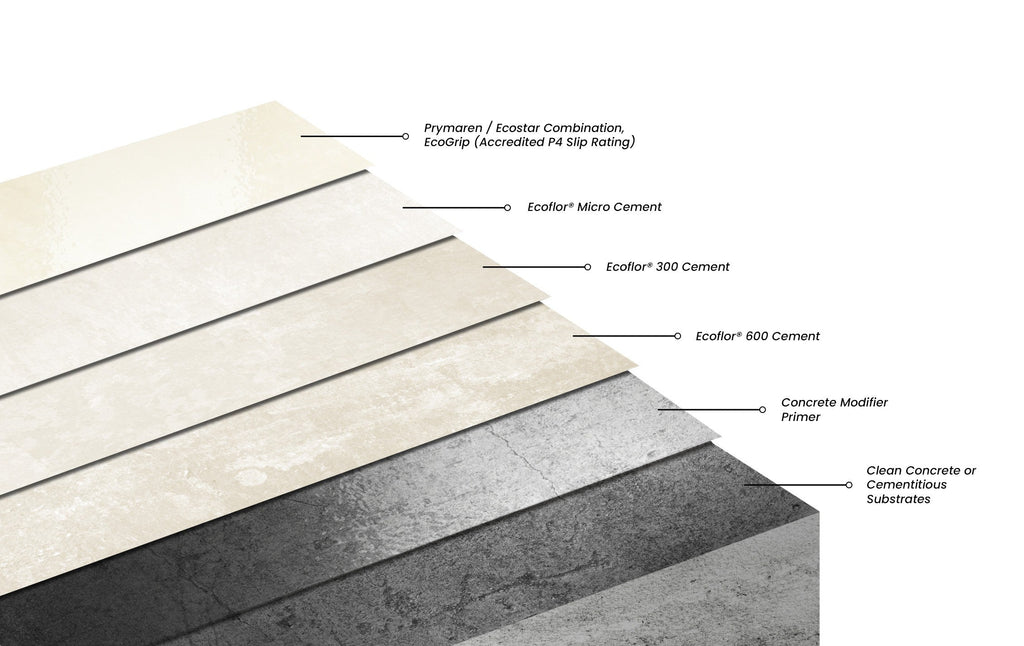
Part of the reason this gets missed is that "microcement" is often marketed as a single, opaque layer. In reality it's a multi-layer system, and each layer plays a different role. The diagram below shows the full Ecoflor build-up over an existing tiled surface: a PrimeLock base coat, fibreglass mesh reinforcement, a second PrimeLock coat, then the Ecoflor 600 and 300 cement layers, the Ecoflor Micro Cement finish, and finally the Prymaren/Ecostar sealer combination with EcoGrip on top. The same layer sequence is used when installing over a compliant waterproofing membrane instead of tiles.

The Ecoflor microcement system build-up, shown here over tiles. The same sequence of layers is used over a compliant waterproofing membrane.
Why Ecoflor doesn't build its system around total impermeability
Ecoflor's approach is the opposite. Rather than trying to make every layer a perfect vapour seal, the Ecoflor microcement and sealer system is designed to let moisture that does find its way in continue to move, so it can dry out through the surface rather than getting trapped behind it.
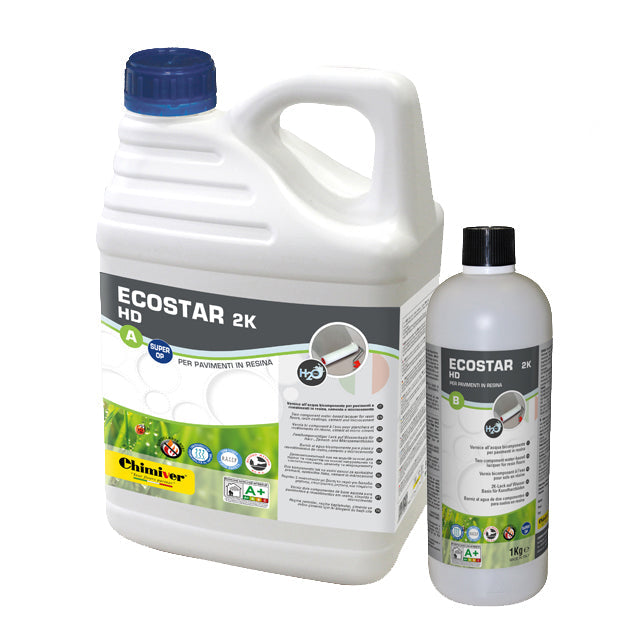
That's not just a design philosophy. Ecoflor's sealer, Ecostar 2K HD, has been independently tested to a recognised international standard for water vapour transmission and verified as allowing a measured rate of vapour movement rather than acting as a total seal (full lab results available on request). It's also been separately tested for resistance to sustained humidity and condensation (UNI EN ISO 6270-1): 120 hours of continuous one-sided condensation exposure at 38°C and 100% relative humidity, with a result of zero blistering, zero cracking, and zero flaking. That's a different test to the vapour transmission figures above, since it measures how the coating holds up under sustained surface condensation rather than moisture specifically trapped behind an installed system, but it points the same direction: a coating engineered to cope with sustained moisture exposure rather than simply trying to exclude it entirely.
That matters most at exactly the failure points described above. If a small amount of moisture does get behind the surface at a joint, a penetration, or a fitting, a vapour-permeable system gives it a path to dry out. A fully impermeable one doesn't. It just accumulates pressure until it fails.

Frequently asked questions
Is microcement waterproof?
Microcement itself is a decorative, water-shedding surface finish, not a substitute for a compliant waterproofing membrane. In Australia, a wet area microcement installation meets the National Construction Code only when the microcement is applied over a membrane that complies with AS 4858, as part of a system that satisfies AS 3740.
What causes microcement to delaminate or blister in a shower?
The most common cause is moisture trapped behind the surface, usually entering at wall-to-floor junctions, wall-to-wall junctions, or around tap and mixer penetrations. If the finish above that trapped moisture is fully vapour-impermeable, the moisture has no way to escape and builds pressure until it lifts the bond.
Does Ecoflor microcement need a waterproofing membrane underneath?
Yes. Ecoflor microcement is designed to be installed over a compliant waterproofing membrane in wet areas, in line with AS 3740 and AS 4858, rather than marketed as a standalone waterproofing layer.
Is Ecoflor's sealer vapour permeable?
Yes. Ecostar 2K HD, Ecoflor's sealer, has been independently lab tested for water vapour transmission and shown to allow a measured rate of vapour movement rather than fully blocking it, and separately tested for resistance to blistering, cracking and flaking under sustained humidity and condensation exposure.
Related post
16
Sep
03
Aug
10
Jul
18
Oct
RECENT POSTS
16.September.2026
Is Microcement Actually Waterproof? What "100% Waterproof" Marketing Claims Leave Out
0 Comments
03.August.2026
How to Seal a Microcement Floor: A Complete Guide to Prymaren + Ecostar 2K HD
0 Comments
10.July.2026
Should a Concrete Overlay Be Stronger Than the Slab Underneath? What the Research Says
0 Comments

18.October.2023
Is Your Concrete Floor Suitable for Polishing? What 250+ Projects Taught Us
0 Comments

18.October.2023
Commercial Concrete Floor Finishes: Choosing the Right Look for Hospitality Spaces
0 Comments