Should a Concrete Overlay Be Stronger Than the Slab Underneath? What the Research Says
A cementitious skim coat or overlay shouldn't be specified stronger than the concrete substrate it's bonded to — and that's not a limitation of the product, it's established concrete repair science. Industry instinct treats a higher compressive strength (MPa) rating as a mark of quality. The research on restrained shrinkage cracking says close to the opposite: for a thin, bonded, non-structural overlay, a lower strength than the substrate is usually the better-performing, more crack-resistant choice.
The Real Compatibility Factor Isn't Strength — It's Elastic Modulus
According to ACI Committee 364 (ACI 364.5T-10, American Concrete Institute), the property that actually governs how well a repair material performs is its elastic modulus relative to the substrate, not its compressive strength in isolation. For structural, load-carrying repairs, a similar modulus to the substrate is wanted. For non-structural, protective or cosmetic repairs — the category a decorative overlay or skim coat falls into — a lower modulus than the substrate is the better fit. A higher-modulus material carries more of the shrinkage and thermal load and concentrates that stress at the bond line, which is exactly where debonding and cracking start. Compressive strength and elastic modulus move together in cementitious materials, which is the underlying reason the "don't exceed the substrate" rule of thumb exists in the first place.
Why Higher-Strength Overlays Crack Sooner
A 2018 study by Beushausen and Arito (Construction and Building Materials, vol. 174) tested 40 different repair mortar mixes spanning 10–60 MPa in 28-day compressive strength, using the ASTM C1581 restrained shrinkage ring test. The finding: higher-strength mortars cracked at earlier ages than lower-strength ones under restrained shrinkage — the exact condition a thin overlay bonded to a rigid substrate is under. The effect plateaus above roughly 35 MPa, a point the researchers labelled the "cracking threshold" — pushing strength higher than that doesn't meaningfully improve cracking resistance, it just adds cement content and cost.
The "Stronger Must Be Better" Assumption Is Costing Durability, Not Adding It
This research, published more fully in Jarratt and Beushausen's 2025 paper on concrete repair sustainability, found that commercially available "high-performance" repair mortars over 40 MPa often contain 40–100% more cement than lower-strength alternatives — with no structural upside. A related analytical study modelling a repaired concrete column found that even a high-strength, high-modulus repair material loses most of its share of a sustained load within days to weeks, due to creep and shrinkage. In other words: specifying a stronger overlay doesn't just risk more cracking, it usually doesn't even deliver the extra structural contribution it's assumed to provide.
How Ecoflor's Base Coat Measures Up
Independent NATA-accredited testing (Sharp & Howells, Test Report No. 6730, AS 1012) measured Ecoflor MicroConcrete Base Coat + Concrete Modifier — the same lab report behind our deep dive on Ecoflor's tested strength — at:
| Curing time | Compressive strength | Flexural strength |
|---|---|---|
| 1 day | 6.9–9.2 MPa | 3.1 MPa |
| 7 days | 15.5–17.5 MPa | 4.8–5.8 MPa |
| 28 days | 20.0–20.5 MPa | 6.0–6.2 MPa |
At 20 MPa, the Base Coat sits comfortably under the 35 MPa cracking threshold, and it doesn't exceed a typical concrete substrate anywhere across the usual 20–40 MPa range installers work over (see our guide on what makes a concrete slab suitable for polishing for context on that range). Against a 20 MPa slab, it's a close match — the ideal case where modulus compatibility matters most. Against a 40 MPa slab, it's roughly half the substrate's strength, which is the correct trade-off for a non-structural, cosmetic base coat: it isn't there to carry load, it's there to stay bonded and resist cracking.
No Glass Fibre Mesh Required
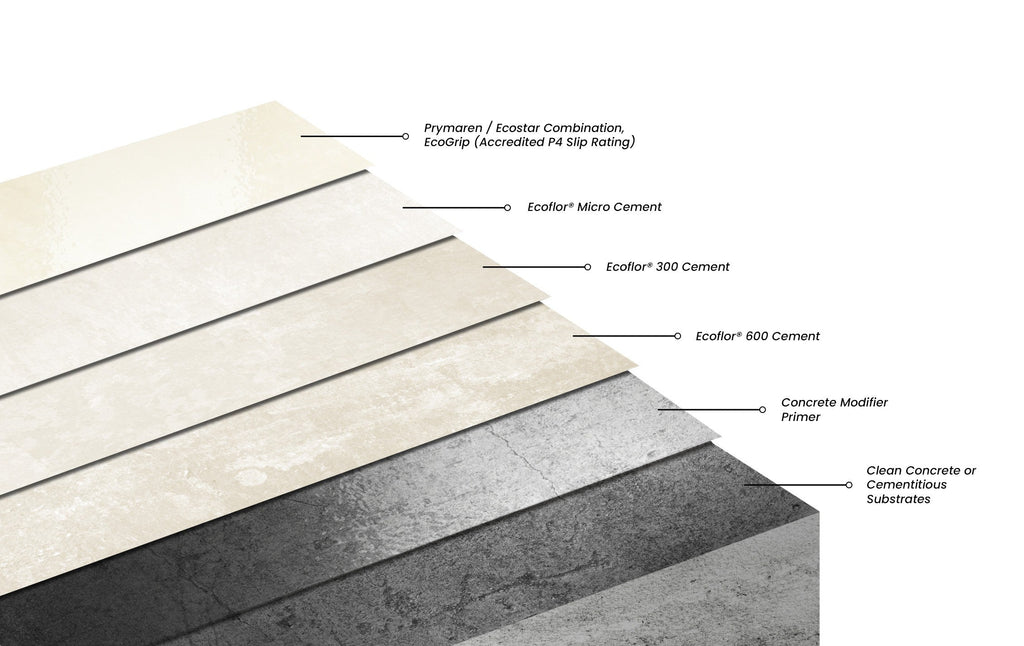
Many competing microcement systems lead with high compressive strength as a selling point, then specify glass fibre mesh reinforcement to manage the cracking risk that comes with it. Ecoflor's Base Coat doesn't carry that requirement. Formulated at 20 MPa — under the research-identified cracking threshold, and matched to typical concrete substrates rather than exceeding them — the system is engineered to be highly crack-resistant without needing a reinforcing layer.
Part of that comes down to the polymer used. Ecoflor's Base Coat is formulated with a liquid acrylic polymer rather than the powdered (redispersible) polymers common in competing systems. It's a deliberate formulation choice: a liquid polymer disperses fully and consistently through the mix from the outset, supporting a flexible, water-resistant bonding matrix that reinforces the coat's crack resistance and adhesion to the substrate — without relying on mesh to hold it together.
FAQ
Does a lower MPa rating mean a lower-quality overlay?
No — for a thin, bonded, non-structural overlay, a lower compressive strength than the substrate is generally associated with better crack resistance and bond performance, not lower quality.
What is the "cracking threshold" concrete repair research refers to?
Research testing 40 repair mortar mixes found that increasing 28-day compressive strength above roughly 35 MPa didn't meaningfully improve resistance to restrained shrinkage cracking — it only added cost and cement content.
How does Ecoflor MicroConcrete Base Coat compare to a typical concrete slab?
Independent NATA-accredited testing measured the Base Coat at 20–20.5 MPa at 28 days — below the 35 MPa cracking threshold and at or under the strength of concrete substrates across the usual 20–40 MPa range it's applied over.
Does Ecoflor MicroConcrete require glass fibre mesh reinforcement?
No. Formulated with a liquid acrylic polymer and kept under the cracking threshold identified in independent research, Ecoflor's Base Coat is engineered to be highly crack-resistant without requiring mesh reinforcement — unlike many competing high-strength systems.
Related post
16
Sep
03
Aug
10
Jul
18
Oct
RECENT POSTS
16.September.2026
Is Microcement Actually Waterproof? What "100% Waterproof" Marketing Claims Leave Out
0 Comments
03.August.2026
How to Seal a Microcement Floor: A Complete Guide to Prymaren + Ecostar 2K HD
0 Comments
10.July.2026
Should a Concrete Overlay Be Stronger Than the Slab Underneath? What the Research Says
0 Comments

18.October.2023
Is Your Concrete Floor Suitable for Polishing? What 250+ Projects Taught Us
0 Comments

18.October.2023
Commercial Concrete Floor Finishes: Choosing the Right Look for Hospitality Spaces
0 Comments